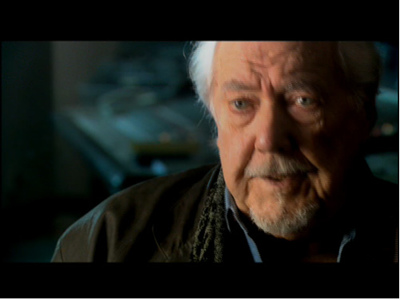
12 Words of Filmmaking Wisdom from "A Decade Under the Influence"—Part 2


1. Orson Welles—I believe that a work is good to the the degree that it expresses the [artist] who created it.

2. Robert Altman re: "M*A*S*H"—All we have to do is stay hidden, not go over budget, don't do anything to draw attention to ourselves, keep our mouths shut and make our picture.

3. Sydney Pollack re: "M*A*S*H"—…who wasn't afraid? How were these guys not afraid because until that time there was something sacred about that, this was a war, the United States was at war, you don't poke fun at this stuff.

4. Julie Christie re: Robert Altman—By breaking the rules he created a sort of template for so many things that came after, like subversion of genre.

5. Robert Altman—I don't tell stories. Stories don't interest me. There's only about six stories. Basically I'm more interested in behavior. What it is simply is I want to see something onscreen that I've never seen before.

6. John Calley (former Warner Bros. executive)—Having been a producer, I felt the balance of power should shift to the director. I felt that it was inherently a director's medium, that the most exciting filmwork was being done by those filmmakers who had control like Fellini and Visconti…Felt that they [filmmakers] didn't need producers to be parental towards them.

7. Marshall Brickman (writer) re: Woody Allen—[Allen] used to always say, if you act like an artist, they'll treat you like an artist.

8. Clint Eastwood re: Michael Cimino's script for "Thunderbolt and Lightfoot"—What kind of mind is writing this? This guy is bizarre but fun. Bizarre is great as long as you're having fun. The relationships [among the characters] was great, too.

9. Paul Mazursky—My feeling was, there's nothing we couldn't do, there's nothing we couldn't try.

10. Robert Towne—The idea of barriers being broken and the promise of being able to do whatever you could imagine was very exciting. There was a sense of a new freedom and it was up to you to have the imagination to push it wherever and however far you could.

11. Sidney Lumet re: Dog Day Afternoon—I said to the cast, the only way I know of avoiding any sensationalism and any sense of exploitation is if you make this so much your own that they see nothing but human beings up there. The humanity of it will stop any sense of outrageousness [of the audience towards the gay characters.]

12. Ellen Burstyn re: Bob Rafelson's casting in "The King of Marvin Gardens"—That's kind of typical of the attitude of the time, of Bob Rafelson, of BBS, which was this is the conventional or the expected thing to do, let's flip it and do it the opposite.

5 Filmmaking Lessons From "The Pixar Story"


I just recently discovered the 2007 documentary "The Pixar Story," a behind-the-scenes look at the creation, struggles and accomplishments of probably the most successful film studio in history. In addition to the usual rise-to-greatness story, the film also contains of insights into the mindsets of filmmakers. I took 11 pages of notes as I watched it! Don't worry, I won't force all of that information onto you. Instead, I'll share what I think are the five most helpful lessons one can learn from watching this documentary.

1. Filmmaking is collaborative but the end product is the director's vision.
As Pixar began production on its first film with Disney Studios—"Toy Story"—they were bombarded with Disney input. Disney's then chairman of the studio, Jeffrey Katzenberg, wanted all Disney films, including Toy Story, to be "edgy." Pixar obliged this request, addressing every note and jumping through every Disney hoop. 

The result?

A disastrous animatic that was described as: not funny, not moving, not emotional and with characters that didn't quite work, especially Woody, who was mean-spirited. It was clear that this wasn't the film Lasseter had intended to make.

The response to the animatic was so dismal that Disney shut down production and told Pixar to lay off staff. Pixar did neither. Collectively they said, "screw it," trashed the storyboard and jumped back in with a fresh mindset of, "What do we want? What would be the funniest thing?"

They listened to their guts 100%, were brutally honest and worked non-stop. They were empowered and excited because they were finally making the movie they wanted to make. Lasseter knew that the story drove every choice and he confidently had every frame in his head. Their energy produced a new animatic in an unheard of 2-3 weeks which, when presented to Disney, showed the film's potential.

Production was resumed and the rest is history!

2. A support system is necessary.
When Lasseter returned home exhausted from the international press tour for "A Bug's Life," he intended to take time off, recharge and remind his family that he existed. Before he could do this, he learned that "Toy Story 2's" status had been upgraded from direct-to-video to theatrical release and that it was currently a mess. Lasseter's wife understood why he had to swoop in and rescue the production but she made it clear that he'd have to keep more regular hours.

Kate Capshaw reportedly made the same request of husband Steven Spielberg when he was in the process of creating Dreamworks studio; go ahead and have your studio but make sure you're home for dinner every night.

In other words, love and understanding from one's family are essential not only to a creative person's success, but also to maintaining the life balance that feeds the creativity.


3. Be fearless. Be different.
Steve Jobs saw what others overlooked: Pixar's potential. He jumped in and supported the company even at its most desperate moments. Although he lost over $1 million per year during Pixar's first five years, he bravely took the long view because he saw what the company was trying to accomplish even before they accomplished it. Jobs knew that Pixar was way beyond what everyone else was doing. His attitude made it easier for Lasseter to decide to go in a different direction from the usual Disney films—no musicals, no fairy tales. No other studio understands nor embraces fearlessness and originality as completely as Pixar does.

4. Overnight success takes years.
Pixar's original form was created in 1979. John Lasseter joined in 1984. Pixar released it's first feature in 1995. During those years, there was experimentation, commercials, live-action effects and animated shorts. That's a lot of years of a lot of work before the triumph of "Toy Story." It was during those lean years that—while working on the short "Red's Dream"—Lasseter had to share one computer with three other guys! He took the late shift, doing most of his animation between 10:30pm and 5am. He kept a futon under his desk; his assistant would wake him in the morning and he'd get right back to animating. He did this routine for weeks. THAT'S dedication. As Brad Bird aptly noted at the end of the film, "Film is forever; pain is temporary."

5. Enthusiasm can change minds and open doors.
I'd read this before in Napoleon Hill's Think and Grow Rich but didn't fully believe it until this film showed me some real-world examples. 

Lasseter showed Tim Allen sketches of Buzz Lightyear hoping to convince Allen to do the film. But it wasn't those sketches that won Allen over; it was Lasseter's enthusiasm. It was this same enthusiasm that fired up a most likely demoralized "Toy Story 2" crew to get the film ready for release in a mere nine months.

Enthusiasm can make the sale when other methods fail.

I highly recommend watching the documentary but if you don't, hopefully you'll find these summarized lessons useful.

Lacking Story Ideas? Two Ways to Get You Started

John K. described on his blog a pitch meeting he had at Dreamworks Animation. To summarize: before he could even show his work, he was told that before considering characters, they first determine an arena. Arenas—according to their definition—are environments (desert, sea, forest, etc.) that contain potentially funny animals that would make good characters for a movie.

Upon first reading about this, I admit I thought it was absurd, as did many other animators and cartoon aficionados. But upon second thought, this idea of "arenas" is an excellent starting point for story ideas. And getting started with generating ideas is half of the challenge.

Method 1 for generating story ideas: make a list of all of the places where a story can occur. He's a partial list I made two years ago:


This list ended up being about 3 pages. I actually got the idea for my current project from this list! So although this method may seem silly, its success is measured by how effective it is in getting you closer to your goal.

Method 2 for generating story ideas is described here—in comic book-like fashion—by Frank Chimero, graphic designer and illustrator. Here's a sample:


Basically, he encourages alogical yet meaningful connections. Ya gotta read it to get it and once you get it, you'll never find yourself wanting for an idea again!

Want to be More Creative & Productive? Sleep Better With These 10 Methods


Indie animator M dot StrangE learned after completing his first feature film, "We Are The Strange," that eating properly and getting enough rest are essential to productivity and creativity.

From the Dumb Little Man site, here's a summary of the 10 ways to improve your sleep:

1. Increase vitamin D

2. Decrease stimulants

3.  Have some tryptophan for dinner

4. Avoid eating or drinking alcohol closer to 2 hours before bedtime

5. Relax the senses

6. Set the bedroom mood

7. Still your mind

8. Drown out your thoughts

9. Have a morning workout

10. If all else fails, seek professional help

Complete explanations are here.

Which will improve your health!

Which will improve your ART!

5 Steps to Create a Gag Cartoon

Step 1: Initial idea

This cartoon started out innocently enough. The idea was to have a law firm run by dogs. This dated note below shows the idea for the scene (a partners's meeting), the punchline (in quotes) and the name of the firm (the list of dog breeds).


Step 2: Thumbnail

This is an important step. This is when you determine if your original written idea will "read" properly once drawn. 

In this case, there were five elements that needed to be made clear to the viewer: the speaking dog, the listening dog, the human, the sign of the name of the firm and the location (an office). I had to figure out the best way to arrange these five elements in the space so that the viewer would immediately understand at what they were looking.


Generating numerous thumbnails is a helpful method for arriving at the best solution. You're not striving for a perfect drawing when creating thumbnails; instead, you're exploring all of the options to discover which works best. I also started creating various versions of the punchline, searching for the most succinct (and funny!) wording.

I used different colors (blue, green, burgundy and graphite) to differentiate among the elements as I arranged them, keeping them apart to avoid confusion as I worked out the idea.

Step 3: Rough drawing
Now it's time to take the thumbnail and make it into a larger, more detailed drawing. In my case, after thinking about and drawing the layout several times, I realized that my original staging of the cartoon was not working well. I created a new thumbnail with which I was satisfied and made that thumbnail into my rough drawing.


Step 4: Cleanup drawing

Now you take the rough drawing and do a clean, more revised and detailed drawing.

When I first did this drawing, I was happy with it. I put it aside and returned to it several days later.

Upon second review, I saw a few things wrong with it! First, I didn't like the listening dog's face. I had reverted to my usual way of drawing…flat. So I applied what I've been learning lately and redrew the dog using three-dimensional shapes, not just outlines. Second, although I liked the cartoony forward leg of the human, I realized that his perspective was off in relation to the floor and ceiling lines. That definitely needed to be fixed otherwise it would look super amateurish which is the exact opposite effect I'm attempting. Those errors I fixed in the final drawing.

Step 5: Final drawing

This step involves copying the rough drawing, "perfecting" your lines and adding tone/color. Some artists make a tight rough drawing and simply ink over the rough to get clean lines for the final. Other artists feel that some life is lost by doing a direct copy so they use the rough merely as a guide for the final. How you create your final drawing is up to your own preferences and style. 

In my case, I adjusted some elements and added some tone. Voila, a cartoon is created!


7 Ways to Unblock Your Imagination


 James Gurney's wonderful website shares 7 ways to activate your imagination. The list provides explanations of the methods. Here's a summary:

1. Imagine a story behind the model's pose.

2. Keep a sketchbook dedicated solely to image generation rather than observation.

3. Refrain from using photo reference initially.

4. Learn to draw from a mannequin figure from memory.

5. Do memory drawings.

6. Do multi-figure compositions.

7. Learn to draw independently from the model.

Francis Ford Coppola's Thoughts on Filmmaking

Photo via Grazia Magazine.

I just read an incredibly informative interview with Francis Ford Coppola here. He reveals his three rules for filmmaking, adapting books to movies, risk, screenwriting and directing. I found it to be a treasure of information.

But I nearly gasped when I saw this quote, "Maybe the students are right. They should be able to download music and movies. I'm going to be shot for saying this. But who said art has to cost money? And therefore, who says artists have to make money?"

Wow, I couldn't disagree more. Coppola's basically devaluing his own work! How and when was it decided that the creation of "art" has no value? Is every job worthy of payment except for the creation of movies and music? The reason "art" should cost money to consume it is because it cost money to CREATE it! Usually numerous people are involved in the creation of movies and music. How do we justify not paying them for their time and work?

I see young people constantly consuming movies and music. But despite the importance it apparently has in their lives, they don't want to pay for it?! Don't they pay for everything else in their lives—their clothes, their MP3 players, their tv's, their video games and consoles, etc. What's the justification for paying for those things—things CREATED by other people—and not paying for music and movies? Maybe their XBox's and Urban Outfitters clothes should be free, too!

Art gives something to the viewer—an experience that they otherwise would not have had if not for the particular vision of the artist. Therefore, the viewer should give back to the artist in the form of payment. Think about what "Star Wars" and "Harry Potter" have done for the imaginations of millions of people. I think George Lucas and J. K. Rowling deserve every penny they've charged for the pleasure of experiencing their creations.

I think I'm particularly sensitive about this issue of "free" since I work in graphic design, an industry that has seen a tremendous devaluing in the last 10 years. People think that since layouts, typefaces and photos are readily available online that combining these elements together into a piece that communicates effectively is easy and requires no craft. I had a former colleague ask me to do some design for free. I politely declined for this very reason; I didn't want to contribute to the devaluing of my work.

Having said all of that, I DO believe there's a difference between making a living and making a killing. I don't think any of us artists should expect to make a killing. I discussed before the idea of redefining success in a culture that values only youth and extreme wealth. We can live fulfilling lives by making a good living; we don't all need Bill Gates or Oprah Winfrey dollars.

Remember: ALL work—all human endeavor—has value. When we start devaluing music and movies, we undermine their importance in society and sow the seeds of their destruction.

Creative Work vs. Reactive Work

Carrie Underwood, genuine talent.

Kardashian sisters, nothing to offer except sex tapes and big asses. Not exactly the qualities that bring you a long career.


Another article about productivity from The 99%. It was the title that caught my eye, "The Key to Creating Remarkable Things."

YES, THAT'S EXACTLY WHAT I'M TALKING ABOUT!!!

REMARKABLE!

We're in a culture and an era of disposable. Kardashians, anyone? But I don't want to be a part of that, I want to be one of the exceptional, one who's remembered for doing something exceptional.


One of my favorite quotes from this article: "We don't find it remarkable when our expectations are met – only when they are exceeded, or when we are surprised by something completely unexpected."


That sentence sums up exactly what's absent from American entertainment today—too many marginally talented people and projects being presented as exceptional. 


And my second favorite quote: "The thing is, if you want to create something truly remarkable, it won't be built in a day. A great novel, a stunning design, a game-changing software application, a revolutionary company – this kind of thing takes time, thought, craft, and persistence."


OH MY GOD, THIS IS SOOOO TRUE!


That quote sums up what I think is wrong with Tyler Perry's work—no time, thought or craftsmanship. His films always feel like a first draft. I read that Perry writes his scripts in two weeks; no comment about rewrites. NO film should be shot with a script that took only two weeks!


I'm going to apply the tips listed in this article and see what happens.

Drawing the Planes of the Head

An important area of study which with I've always struggled is memorizing and understanding the planes of the head. When I was first approached this subject in the summer of 2010, none of it made sense. I was trying to understand this page from the Andrew Loomis planes from his book "Drawing the Head and Hands":


For some reason, I couldn't "get" it. I couldn't remember the location of the planes, I kept forgetting them and eventually abandoned learning them. But I knew I had to go back to it eventually because it's vital to drawing; the head CANNOT be properly depicted without understanding how light falls on it which means knowing the planes.

I don't know what happened between now and then but I suddenly understand the planes. I think it's because I'm now relating the planes of the head to what causes the planes which is, of course, the skull! The planes are directly related to the shape of the skull and, to a lesser extent, the facial muscles. NOW it makes sense!

It also helped to use other diagrams in addition to Loomis's. There are various ways to depict some of the planes, some ways more complicated then others. Here's some of the photo reference I've been using to study the planes:


This is from James Gurney's website. I based my studies of the front of the head primarily on this drawing.

These Asaro heads are really helpful for understanding the planes in profile.

The Fred Fixler planes, particularly helpful in showing the 3/4 view.

Another 3/4 view for studying via the Asaro head.

As you can see, each of these examples varies slightly. I was originally overwhelmed by the differences. But once I realized that the differences are minor, I set about just absorbing the approaches that made the most sense to me. What makes sense to me is more likely to be retained than pure memorization.

Happy studying!


Prolong Your Creative Productivity


I came across this article at The 99% website.

Since productivity and maximizing time are important to me, I found these suggestions to be helpful. I easily begin to feel burned out so I discovered awhile ago that switching from drawing to the computer and vice versa helps keeps me going.

Basically, whatever works for you is RIGHT and don't let anyone tell you different!

Amazing Animation—Nick Cross's "The Pig Farmer"


Nick Cross's bio from the ASIFA-Hollywood site: Nick Cross is a self taught animator/independent filmmaker who also works commercially. His professional credits range from music videos to television. While working a full schedule, Nick is able to animate short films entirely on his own to a standard higher than most. Some of his films include "The Waif of Persephone" and "Yellow Cake." 


He recently completed "The Pig Farmer" which is can be viewed here. All I can say is that he's an inspiration.

Animation Oscar Nominations

CartoonBrew has the animated short and feature Oscar nominations here with links to info about the shorts. I feel for Bill Plympton, he said on his blog that an Oscar nomination for "The Cow Who Wanted to be a Hamburger" which surprised me considering how long and successful his career has been. Maybe he meant that a nomination would give his career a boost.

Plympton also said that all of the short nominations are "computer films." I'm not sure if that's accurate. Teddy Newton's "Day and Night's" characters are—according to this explanation—2-D animation with 3-D animation existing inside of them that reflects the characters's emotions. This video gives an explanation.


Based on the clips I've seen of this film—and the Academy's alleged preferences for both West Coast animators and 3-D animation—I believe Newton will walk away with the Oscar. I'm also intrigued by the idea of this film and its execution and look forward to seeing it in its entirety (haven't seen Toy Story 3.)

The only other short film I have any familiarity with is "Madagascar, A Journey Diary." I saw this still from the film that blew me away. I've also seen scenes of the film and it not only looks like a watercolored travel diary but it includes some great technical shots. I can definitely see why this was nominated.


After a quick search, I found the film for download here. This is surprising because I thought films online were ineligible for Oscar consideration. Plympton said his "Santa: The Fascist Years" —one of his recent best films, I think—wasn't eligible for Oscar consideration when it was completed. 

The other short nominations:
"Let's Pollute"

"The Gruffalo"

"The Lost Thing"

Best of luck to all of the nominees!